

In Greece, electricity consumption over the past 12 months, from June 2025 to May 2026, reveals a nearly even split between fossil fuels and low-carbon energy sources. Fossil energy, including gas, coal, and oil, still constitutes more than half at approximately 50.3% of total electricity production, with gas alone delivering over four-tenths of the country’s electricity needs. On the low-carbon front, 49.68% of electricity comes from clean sources: wind power provides the largest share at over a fifth, solar energy follows with almost a sixth, and hydropower contributes a little more than a tenth. This balance between fossil and clean energy sources represents an opportunity for growth in green energy, which can help mitigate climate change and reduce air pollution.
Is Electricity Growing in Greece?
Electricity consumption per person in Greece has seen a decline from its peak in 2008, where it registered at 6261 kWh/person, to the latest figures of 5409 kWh/person in 2026, marking a decrease of 852 kWh/person. However, not all trends are negative; there is promising growth in low-carbon electricity. Greece's recent increase in low-carbon electricity generation has reached 2687 kWh/person, a rise of 123 kWh/person from the previous record in 2024. This upward trend in clean energy generation is worth celebrating, although the overall decline in electricity consumption is cause for concern as it might limit Greece's ability to meet future energy demands driven by electrification and technological advancements.
Suggestions
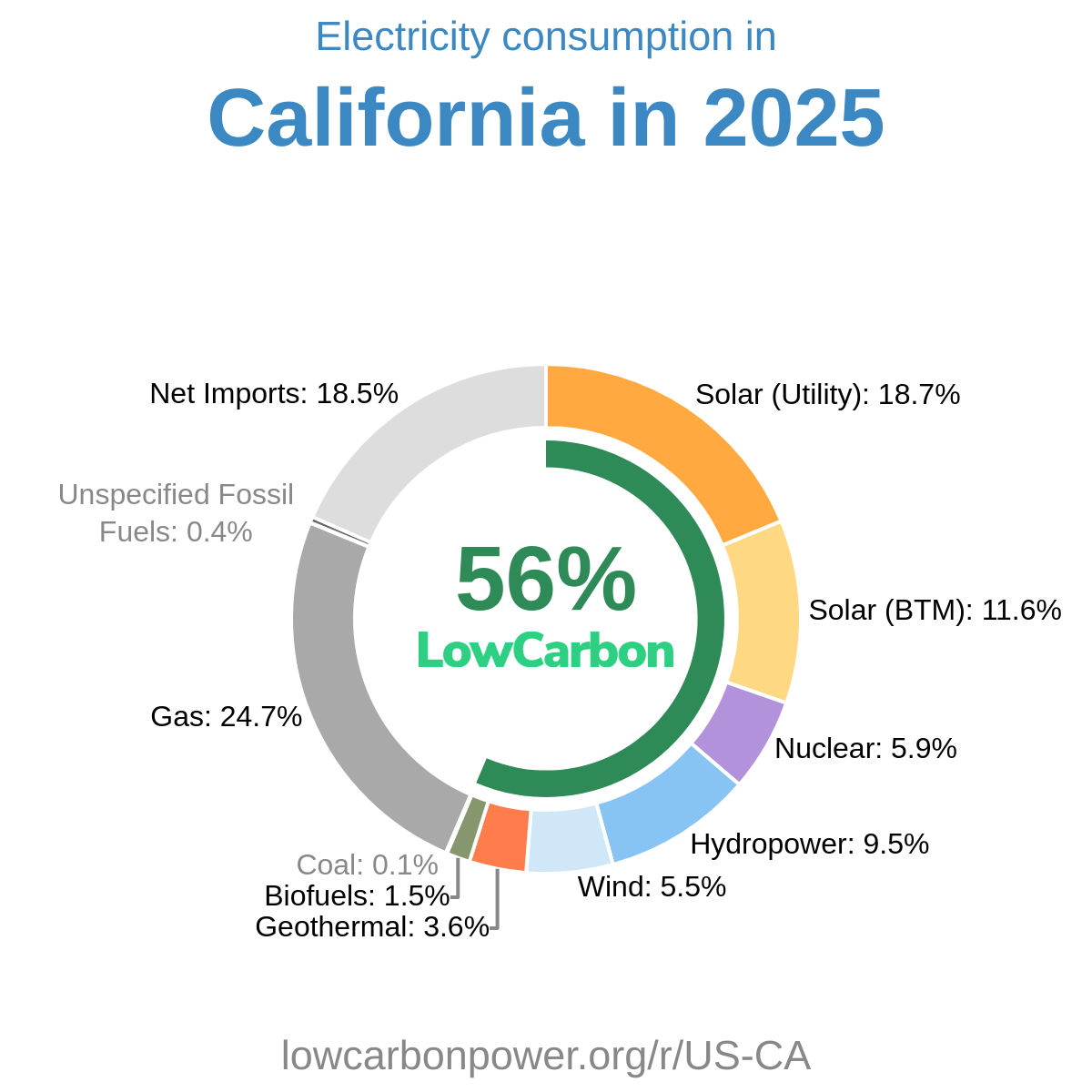
To enhance low-carbon electricity production, Greece should focus on expanding its solar and wind energy capabilities. Wind energy has significant potential given its current contribution and relevance in similar regional contexts like Denmark, which generates 60% of its electricity from wind. For solar energy, Greece can draw inspiration from states like Nevada and California, where solar constitutes a substantial proportion, at 34% and 31% respectively. Additionally, to secure a more sustainable energy matrix, Greece can look towards some European countries that have successfully leveraged nuclear power, such as France, where nuclear accounts for 67% of electricity. Building nuclear capacity can supplement Greece’s existing wind and solar assets, ensuring a continuous, steady supply of electricity that aligns with environmental goals.
* 12M = Last 12 months (Jun 2025 – May 2026) — a rolling 12-month period, not a calendar year.
History
Historically, Greece's journey with low-carbon electricity has seen fluctuating trends, particularly in hydro and solar energy production. In the early 2000s, hydropower experienced both gains and losses, such as a recovery of 1.9 TWh in 2003, contrasted with setbacks like a drop of 3.1 TWh in 2007. Moving into the 2010s, solar energy began contributing positively, with a notable increase in 2013 of 2 TWh. While hydropower has continued to see ups and downs, as in 2021 when an increase of 2.5 TWh was observed, solar and wind power provide a more stable ground for future expansion. Wind energy, for example, had a positive shift in 2020, and though there was a slight decrease in 2025, recent hydropower figures show growth again with an increase of 2.1 TWh in 2026. Continued investment and development in these low-carbon sectors will be critical for Greece’s sustainable energy future.
* 12M = Last 12 months (Jun 2025 – May 2026) — a rolling 12-month period, not a calendar year.
Electricity Imports and Exports
Balance of Trade
* 12M = Last 12 months (Jun 2025 – May 2026) — a rolling 12-month period, not a calendar year.
Nearby Regions